K2F-B-3
DPT: Vision Transformers for Dense Prediction
- Description: DPT (Dense Prediction Transformer) paper note — use a ViT encoder as the backbone for dense per-pixel prediction: reassemble tokens from several transformer stages into image-like feature maps at multiple resolutions, then RefineNet-style fusion upsamples them to a fine-grained output. Global receptive field at every stage -> big gains in monocular depth (zero-shot) and semantic segmentation (ADE20K 49.02% mIoU); the dense-prediction head DUSt3R/CroCo later reuse
- My Notion Note ID: K2F-B-3
- Created: 2026-08-02
- Updated: 2026-08-02
- License: Free to share: please credit Yu Zhang and link back to yuzhang.io
Table of Contents
- 1. Summary
- 2. Key Contributions
- 3. Method
- 4. Experiments & Results
- 5. Strengths / Limitations / Legacy
- References
1. Summary
Title: Vision Transformers for Dense Prediction Authors: R. Ranftl, A. Bochkovskiy, V. Koltun (Intel Labs) Paper: arXiv:2103.13413 (ICCV 2021) Github: isl-org/DPT
DPT (Dense Prediction Transformer) — an architecture for dense per-pixel prediction (depth, segmentation) that swaps the convolutional backbone for a Vision Transformer encoder, keeping an encoder–decoder shape.
Core problem: fully-convolutional dense-prediction nets progressively downsample the image to build up receptive field, so deep features lose resolution and fine detail is hard to recover through upsampling. The bottleneck is structural — once downsampled, information is gone.
Key insight: a Transformer keeps the number of tokens constant through all layers and has a global receptive field at every stage (each token can attend to all others, no downsampling). So representations never lose their granularity, and every stage has full-image context — ideal for dense prediction.
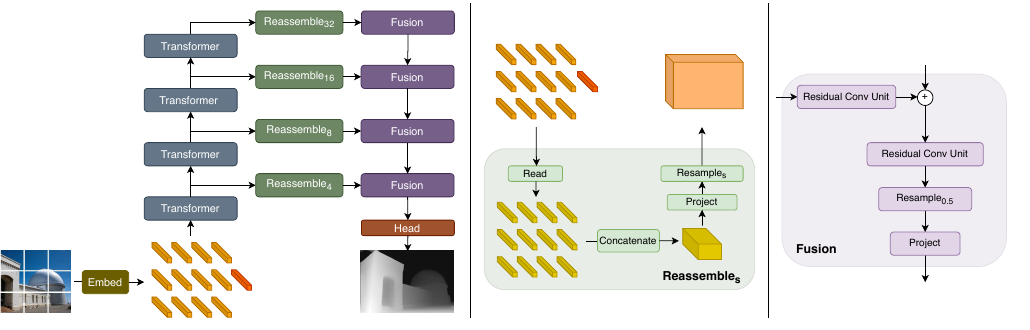
Approach: use ViT as the encoder; then a convolutional decoder turns tokens back into images:
- Reassemble — take tokens from several transformer stages and reshape them into image-like feature maps at multiple resolutions (deeper layers -> coarser, earlier layers -> finer).
- Fusion — RefineNet-style blocks progressively fuse and ×2-upsample these maps into one fine-grained prediction, then a task head.
Main results: on monocular depth, trained on a 1.4M-image meta-dataset, DPT beats the CNN SOTA (MiDaS) in zero-shot cross-dataset transfer by >28% (DPT-Large) / >23% (DPT-Hybrid) average relative improvement; on semantic segmentation sets a new ADE20K SOTA at 49.02% mIoU.
2. Key Contributions
- Transformer backbone for dense prediction — first to show a ViT encoder + convolutional decoder substantially beats convolutional dense-prediction nets of similar capacity, especially with large training data.
- The Reassemble operation — a clean way to recover image-like features from the tokens of arbitrary transformer layers, at a chosen resolution (Read -> Concatenate -> Resample).
- New SOTA — monocular depth (zero-shot transfer) and ADE20K / Pascal Context / NYUv2 / KITTI segmentation & depth.
3. Method
3.1 Transformer Encoder
The image is split into non-overlapping patches, each linearly embedded into a token (ViT-style; DPT-Hybrid instead extracts patches from a ResNet-50 feature map). Add position embeddings and one patch-independent readout token (the ViT [class]-token analog, not grounded in any image location). For an image this gives tokens (+1 readout); transformer layers map them to new representations . Crucially, the token count is constant and each layer is global — no resolution loss. All experiments use patch size .
3.2 Reassemble: Tokens -> Feature Maps
Recover an image-like representation from the tokens of a chosen layer at output size ratio :
- Read () — handle the readout token. Three variants:
ignore(drop it),add(add it to every token), orproj(default: concatenate readout to each token, MLP + GELU back to ). - Concatenate — place each token at its patch's spatial position -> feature map with channels.
- Resample — conv to channels, then strided conv (downsample) or transpose conv (upsample) to size .
Reassemble runs at four stages / four resolutions: deeper layers reassembled coarser, early layers finer. Default head width .
3.3 Fusion & Head
Feature maps from consecutive stages are combined by RefineNet-based fusion blocks (residual convolutional units), each upsampling ×2. The final representation is at half the input resolution; a task-specific head produces the dense output (the head further upsamples to full resolution). Batch norm is disabled in the decoder (found to hurt regression).
3.4 Variants & Varying Image Sizes
| Variant | Encoder | Reassembled layers |
|---|---|---|
| DPT-Base | ViT-Base (12 layers) | |
| DPT-Large | ViT-Large (24 layers) | |
| DPT-Hybrid | ResNet-50 + ViT (12 layers) | ResNet blocks 1–2 + |
Like an FCN, DPT handles varying image sizes (as long as divisible by ): the transformer is set-to-set so it takes any token count; position embeddings are linearly interpolated on the fly; reassemble/fusion handle variable sizes as long as the input aligns to the decoder stride (32 px).
4. Experiments & Results
Monocular depth — trained on MIX 6, a meta-dataset of ~1.4M images (largest ever for the task), with a scale/shift-invariant trimmed loss on inverse depth + gradient-matching loss. Encoder initialized from ImageNet, decoder random; Adam, lr 1e-5 (backbone) / 1e-4 (decoder), 60 epochs.
Zero-shot cross-dataset transfer (Table 1, relative improvement over MiDaS; lower error is better):
| DIW (WHDR) | ETH3D (AbsRel) | Sintel | KITTI | NYU | TUM | |
|---|---|---|---|---|---|---|
| DPT-Large | 10.82 (−13.2%) | 0.089 (−31.2%) | 0.270 (−17.5%) | 8.46 (−64.6%) | 8.32 (−12.9%) | 9.97 (−30.3%) |
| DPT-Hybrid | 11.06 (−11.2%) | 0.093 (−27.6%) | 0.274 (−16.2%) | 11.56 (−51.6%) | 8.69 (−9.0%) | 10.89 (−23.2%) |
| MiDaS (retrained on MIX 6) | 12.95 | 0.116 | 0.329 | 16.08 | 8.71 | 12.51 |
Average relative improvement over MiDaS: >28% (DPT-Large), >23% (DPT-Hybrid). Retraining the CNN MiDaS on the same larger dataset still leaves DPT ahead — DPT benefits more from data, matching the transformer-scaling story from other fields. DPT-Hybrid gets this at comparable capacity/latency; DPT-Large is ~3× larger.
Semantic segmentation — new SOTA on ADE20K (49.02% mIoU), plus strong results on Pascal Context, NYUv2, KITTI. Ablations confirm the default proj readout and .
5. Strengths / Limitations / Legacy
Strengths
- Turns "keep resolution + global context" into a concrete recipe (Reassemble + Fusion) that drops onto any ViT encoder.
- Clean empirical case: beats CNNs at equal capacity, and scales better with data.
- General — depth and segmentation from the same backbone with only a head swap.
Limitations
- Inherits ViT's cost: global attention -> expensive at high resolution / many patches.
- Data-hungry, like ViT — the big wins need large training sets.
- Reassemble/fusion add convolutional decoder machinery and hyperparameters (which layers, , stride) on top of the "pure transformer" idea.
Legacy (why it's in this reading arc)
- The DPT dense-prediction head is reused downstream: CroCo puts a DPT head on its ViT encoder for dense 3D tasks, and the DUSt3R/VGGT line regresses dense pointmaps with DPT-style heads. DPT is the bridge from "ViT gives good features" to "ViT gives dense per-pixel geometry".
References
- Ranftl, R., Bochkovskiy, A., & Koltun, V. (2021). Vision Transformers for Dense Prediction. ICCV. arXiv:2103.13413, code. — source paper (Fig. 1 architecture above)
- ViT: the encoder backbone DPT builds on — read first
- Ranftl, R., et al. (2020). Towards Robust Monocular Depth Estimation (MiDaS). IEEE TPAMI. — the CNN baseline and the mixed-dataset / scale-invariant-loss training protocol DPT adopts
- Lin, G., et al. (2017). RefineNet. CVPR. — the fusion-block design DPT's decoder is based on
- CroCo: next in the arc — reuses a DPT head on a ViT encoder for dense 3D downstream tasks